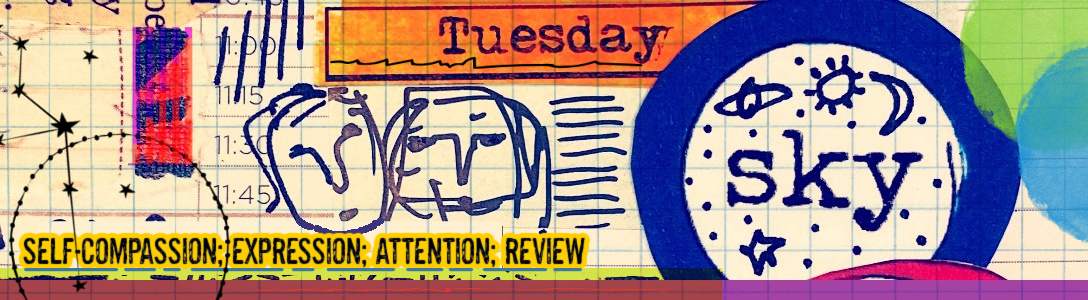

For 2026, I will be reviewing a chapter from The Artist’s Way by Julia Cameron and providing a free download of themed art cards on a monthly basis (third Tuesdays).
“We need to keep our minds prioritized on rooting out the messages of our old stories and focusing instead on the new, rewritten ones.” -Dr. Gail Saltz

“Most of the time when are blocked in an area of our life, it is because we feel safer that way… This is seldom a conscious decision. It is more often an unconscious response to internalized negative beliefs…” -Julia Cameron
Braveheart, I have been reviewing The Artist’s Way chapter 1, “Recovering a Sense of Safety” along with my notes from my last reading. It has been a reminder of how my creative practice has faithfully served as my way through my questions, pain and loss. ❤️
This is a chapter focused on confronting [naming] and letting go of the negative thoughts and beliefs [“the enemy within”] that we have internalized as a result of external influences such as:
- being overwhelmed, mocked and unsupported
- experiencing criticism or made to feel small
- dismissed or mocked for creativity
- “You always have your head in the clouds.”

“Remember that in order to recover as an artist, you must be willing to be a bad artist. Give yourself permission to be a beginner.” -Julia Cameron
When we deny ourselves permission and safe space for our creativity, we experience discontent and “a sense of missed purpose and unfulfilled promise” (Julia Cameron):
“They want to write. They want to paint. They want to act, make music, dance … but they are afraid to take themselves seriously.” -Julia Cameron

Finding a sense of safety and ease can be the result of embracing our desire for creativity and practicing—try over and over ☑️☑️☑️—with our art and creative choices.
This process is enhanced + fostered by reframing (and eliminating) our faulty beliefs with affirming words and practices.
“Make your own recovery the first priority in your life.” -Robin Norwood

Grounding statements (affirmations) are a foundational element of my creative practice. This is often as simple as choosing a guiding word or simple phrase that sets (or redirects) my focus and energies as I meditate and add to my journal pages.
- Pen-to-paper is a simple way to redirect ourselves when we feel distracted, discouraged or overwhelmed.
- An excellent example: 🪄 How drawing can set you free, Shantell Martin
As a practice, guide words + grounding statements are how I move away from faulty beliefs and begin to envision, embrace and experience my desired outcomes.
“Maybe it’s perpetual quest for stability; I want a ritual to hold on to, a recurring photo taken in the same spot every year, or maybe I’m trying to blot out old memories and replace them with happy ones.” -Caitlin Metz

What does all this have to do with right brain planning?
The principal goal of Right Brain Planner is to foster a daily-ish (and/or lunarly) practice of [being present] + [self-compassionately seeing and reviewing] the details of our living by compiling a visual chronicle as a safe place to check in with ourselves. 💖
- Examples of how to pause + check in with ourselves: copy a quotation from something you are reading; snap a photo of the ☁️💙☁️ sky while noticing its details; pull an oracle 🃏 card and reflect on its meaning within your life; jot notes about your day, your 🪄 wishes and/or your 🚨 vents; a quick 📝 chronicle of the moon phases and weather on a monthly 📆 calendar; a one-line journal … there are lots of possibilities, Braveheart. 😊
The focus in developing a right brain planning practice is to see our living as ongoing—a timeline [days within years; years within a lifetime].
- To resist the urge to allow a “bad day” or a “bad week” to become a filter—a lens—that limits our ability to hope and live differently.
- Easing away from a performance-based valuation of self-worth; cycling like the moon and exploring so-called irregularity (stops and starts) as a cycle of wholeness.
Right brain planning is an opportunity to allow our journals to be our “planners”—elevating expression and desires over expectations and shoulds. A safe space to tell our stories.
Thank you kindly for your presence here, Braveheart. 💗
I appreciate your interest and support.
~love & good wishes~
⭐️ I am an artist and curator; I am one who communicates with color, found words and collage, inky marks and doodles as I cycle like the moon (as my calendar), chronicling oracles and abiding with the sky as a meditation.
Artist’s Statement 😊🔮🔎📝🖌️🎨❤️📊
⭐️ I host creative communities, safe spaces for gathering and sharing. I choose love and creativity for coping with the ongoing challenges of this world and I go to work—not because everything is fine but because I believe art heals.
❤️ Braveheart, as the Creator/Artist of Right Brain Planner I am ever-grateful to have the opportunity to share my creative work online + support other creators! 🎉 For almost 20 years I have had the privilege of sharing my art and writing about right brain planning while also hosting kindred 👭🏽💞👭 communities. ✨ I consider it an absolute 🤸 delight to continue this portion of my creative 📝🖌️✂️🫧 work (even as I retire from full-time work).
- This is possible, in part, by {you} and your presence here. (Thank you!) 💗 But also because of the support of my Ko-fi patrons and the other member/subscriber communities I host (via their presence, input and paid subscriptions). 🫶
- 💁🏻♀️ Other ways to support my work: ❤️ continue to read this blog + follow me on Instagram. 📲
If you already have your own system of creative journal-planning, but are interested in financially supporting my creative work, you may do so by making a donation:
- Make a one-time contribution in any amount via [this link]. (Thank you!) ❤️